For decades, leaders of Arab nations in the Persian Gulf viewed their relationship with the United States as a strategic partnership. Donald Trump often saw it differently.
“King, we’re protecting you. You might not be there for two weeks without us. You have to pay for your military,” Trump said in 2018, speaking of the Saudi monarch and encapsulating a more transactional vision of a relationship that Gulf leaders had long regarded as a cornerstone of their security.
A year later, Saudi Arabia suffered the biggest attack on its territory in decades when strikes on key oil facilities temporarily knocked out roughly half of the kingdom’s crude production, sending global oil prices soaring. While Washington blamed Iran and condemned the attack, Gulf states were left with lingering questions about the extent of American willingness to confront Tehran on their behalf.
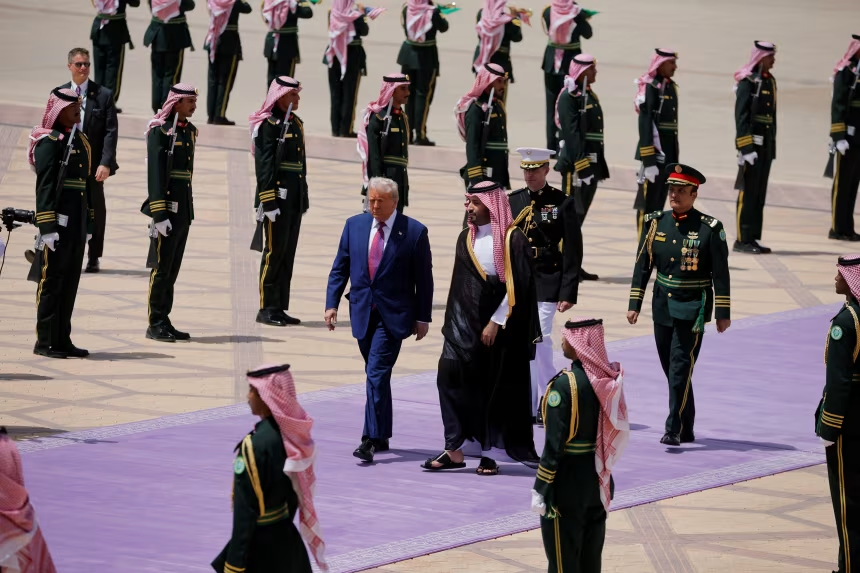
By Trump’s second term, Gulf leaders had taken note. As Gulf states pledged trillions of dollars in investment in the US economy, Trump chose the region for his first official trip abroad.
“We are going to protect this country,” the US president declared in the Qatari capital Doha during his Gulf tour last May.
That pledge faced its biggest test this year. Despite Gulf states’ efforts to avoid a regional conflict, the US – alongside Israel – launched a war against Iran, triggering ferocious retaliatory attacks across the Gulf and forcing regional governments to confront once again the question of what American protection really means.
US Secretary of State Marco Rubio arrived in the region on Tuesday, with the unenviable task of convincing Gulf states that Washington’s security commitments remain intact. Yet for many in the Gulf, the question is no longer whether Washington remains committed to their security, but whether the emerging agreement with Iran leaves them better or worse off than they were before the war.
“From the Arab Gulf states’ perspective, the Iran war is a disastrous turning point for the regional security order,” said Hasan Alhasan, senior fellow at the International Institute for Strategic Studies (IISS), who sees the agreement as part of a broader US retrenchment from the region. “US disengagement from the Gulf and the flow of financial and economic resources to Iran are likely to embolden Tehran further.”
“Nonetheless, the Arab Gulf states have facilitated and supported the Iran-US ceasefire deal. For them, a bad deal is still preferable to war,” he told CNN.
‘We want to hear their thoughts’
Rubio’s tour includes the United Arab Emirates, Bahrain and Kuwait, three Gulf nations that bore the brunt of Iranian attacks during the war and are likely among the most skeptical of the emerging détente between Washington and Tehran.